RM Places/Place details

Quote from kevync on 2026-01-14, 12:51 pmI wanted to carry this conversation here
Report of odd occurrence with place/place details
My understanding of the place table suggests that when placetype =0 then a MasterID would not be expected and value should be Zero. Is that correct? If so -- seems something is cause that to be NOT TRUE but I am not sure why or what maybe have caused it -- to be fair I do not think this started with 11.0.4. (or even 11)
I fixed the issue above but then I looked for more.
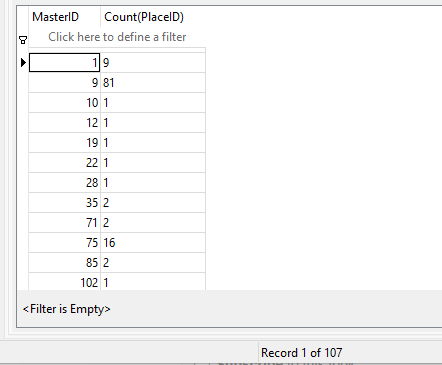
Select MasterID, Count(PlaceID)
FROM PlaceTable
Where PlaceType = 0 and MasterID <> 0
GROUP By MasterIDproduced ~107 rows
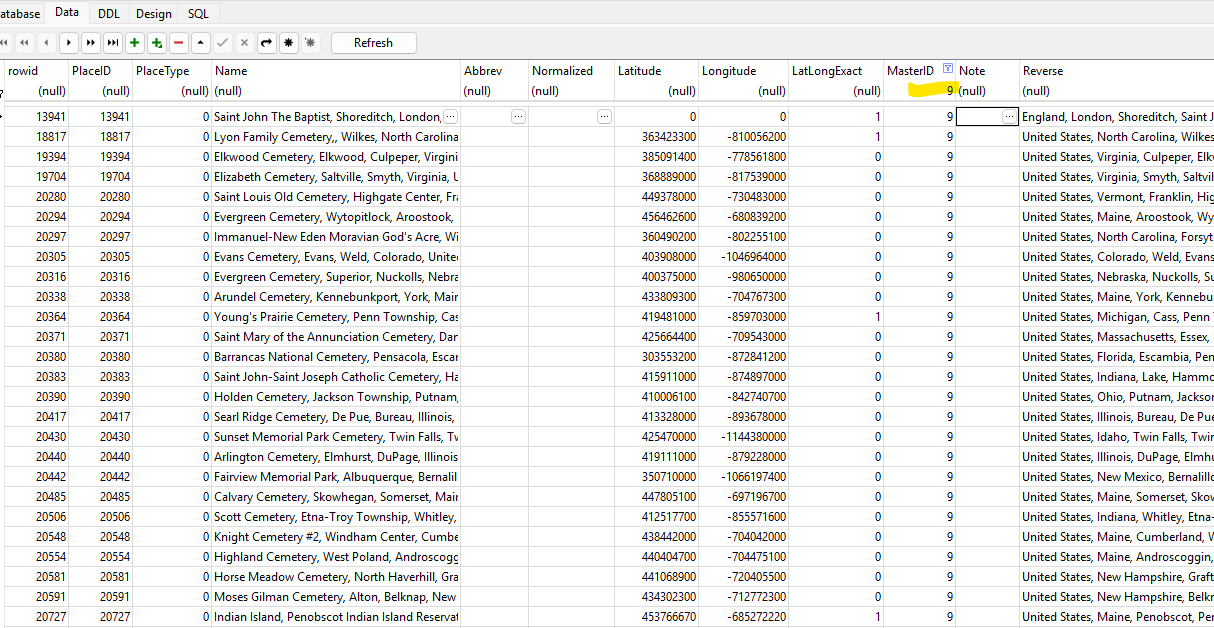
Example of what is linked to MasterID 9
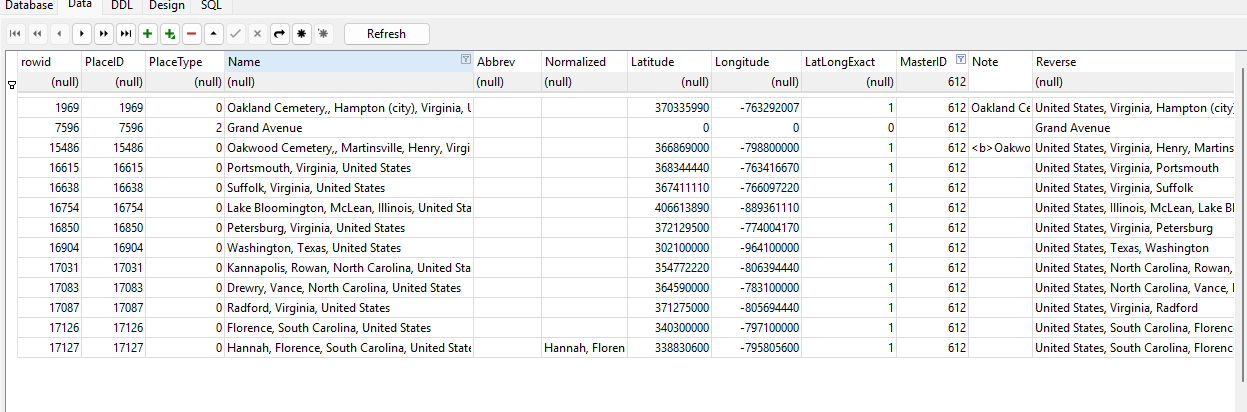
(which is one of the abbreviations -- there are many linked them)or for 612
I wanted to carry this conversation here
Report of odd occurrence with place/place details
My understanding of the place table suggests that when placetype =0 then a MasterID would not be expected and value should be Zero. Is that correct? If so -- seems something is cause that to be NOT TRUE but I am not sure why or what maybe have caused it -- to be fair I do not think this started with 11.0.4. (or even 11)
I fixed the issue above but then I looked for more.
Select MasterID, Count(PlaceID)
FROM PlaceTable
Where PlaceType = 0 and MasterID <> 0
GROUP By MasterID
produced ~107 rows
Example of what is linked to MasterID 9
(which is one of the abbreviations -- there are many linked them)
or for 612
Uploaded files:
Quote from Tom Holden on 2026-01-14, 2:45 pmYou will find a few prior or relevant discussions among the results of this search of this forum. It's not a new phenomenon. In one, I hypothesized it might be the result of a defective or crashed RM Split Place operation, akin to what happens when there's a crash during Add Person.
You will find a few prior or relevant discussions among the results of this search of this forum. It's not a new phenomenon. In one, I hypothesized it might be the result of a defective or crashed RM Split Place operation, akin to what happens when there's a crash during Add Person.
Quote from Tom Holden on 2026-01-14, 3:01 pmAnother prior reference is Place Details without a Place from 12 or so years ago. At that time it was possible to add a Place Detail through the user interface with the Place left blank.
Another prior reference is Place Details without a Place from 12 or so years ago. At that time it was possible to add a Place Detail through the user interface with the Place left blank.
Quote from kevync on 2026-01-14, 3:36 pmI spot checked databases prior to RM11 -- that said its seems to have happened in RM 11 -- this made me go hmm -- maybe related to change in journal modes?
I suspect it might be possible that it related to merging duplicate place with the RM UI.
I spot checked databases prior to RM11 -- that said its seems to have happened in RM 11 -- this made me go hmm -- maybe related to change in journal modes?
I suspect it might be possible that it related to merging duplicate place with the RM UI.
Quote from thejerrybryan on 2026-01-14, 4:27 pmI haven't used PlaceDetails for years. I rewrote your diagnostic query slightly a follows.
WITH BadMasterID AS
(
Select PlaceID, Name, MasterID, Count(PlaceID) AS CC
FROM PlaceTable AS P1
WHERE PlaceType = 0 and MasterID <> 0
GROUP By MasterID
)SELECT A.PlaceID AS PlaceID_A, A.MasterID AS MasterID_A, A.Name AS Name_A, A.CC AS A_CC, B.PlaceID, B.Name
FROM BadMasterID AS A
LEFT JOIN PlaceTable AS B ON A.MasterID = B.PlaceIDThe problem was not there in my RM7, RM8, or RM9 database. It was there in my RM10 database. And it's still there in RM11.
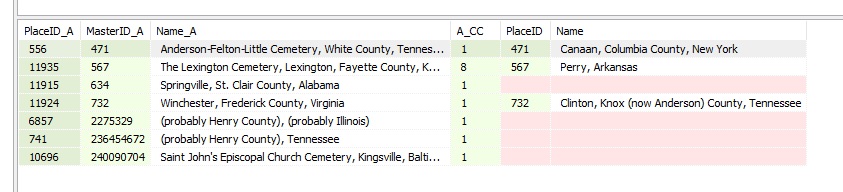
I do get a bit of junk. I couldn't get the image to go into the message, so I did an upload. It looks like there are a few MasterID's that need to be zeroed out.
I haven't used PlaceDetails for years. I rewrote your diagnostic query slightly a follows.
WITH BadMasterID AS
(
Select PlaceID, Name, MasterID, Count(PlaceID) AS CC
FROM PlaceTable AS P1
WHERE PlaceType = 0 and MasterID <> 0
GROUP By MasterID
)
SELECT A.PlaceID AS PlaceID_A, A.MasterID AS MasterID_A, A.Name AS Name_A, A.CC AS A_CC, B.PlaceID, B.Name
FROM BadMasterID AS A
LEFT JOIN PlaceTable AS B ON A.MasterID = B.PlaceID
The problem was not there in my RM7, RM8, or RM9 database. It was there in my RM10 database. And it's still there in RM11.
I do get a bit of junk. I couldn't get the image to go into the message, so I did an upload. It looks like there are a few MasterID's that need to be zeroed out.
Uploaded files:
Quote from kevync on 2026-01-14, 8:17 pmI always get a little confused when to use LEFT vs INNER join -- if I were to do this as an UPDATE query -- wouldn't I want to use INNER JOIN (on last line)?
WITH BadMasterID AS
(
Select PlaceID, Name, MasterID, Count(PlaceID) AS CC
FROM PlaceTable AS P1
WHERE PlaceType = 0 and MasterID <> 0
GROUP By MasterID
)SELECT A.PlaceID AS PlaceID_A, A.MasterID AS MasterID_A, A.Name AS Name_A, A.CC AS A_CC, B.PlaceID, B.Name
FROM BadMasterID AS A
Inner JOIN PlaceTable AS B ON A.MasterID = B.PlaceID
I always get a little confused when to use LEFT vs INNER join -- if I were to do this as an UPDATE query -- wouldn't I want to use INNER JOIN (on last line)?
WITH BadMasterID AS
(
Select PlaceID, Name, MasterID, Count(PlaceID) AS CC
FROM PlaceTable AS P1
WHERE PlaceType = 0 and MasterID <> 0
GROUP By MasterID
)SELECT A.PlaceID AS PlaceID_A, A.MasterID AS MasterID_A, A.Name AS Name_A, A.CC AS A_CC, B.PlaceID, B.Name
FROM BadMasterID AS A
Inner JOIN PlaceTable AS B ON A.MasterID = B.PlaceID
Quote from thejerrybryan on 2026-01-14, 10:08 pmI don't think INNER JOIN vs. LEFT JOIN is the issue in this case. I think you just want the following.
UPDATE PlaceTable
SET MasterID = 0
WHERE MasterID != 0 AND PlaceType = 0;It would work ok without the MasterID != 0 clause, but without including it will update all the MasterID fields for all the Places in your database, including the ones that are already 0. And you won't get a "nothing updated" message when it's done.
The idea is that when PlaceType = 2, you have a Place Detail and the MasterID for a Place Detail is to be joined with a PlaceID for a Place where PlaceType = 0. But when PlaceType = 0 so that you have a Place, the MasterID is meaningless. It doesn't join to anything, no matter if MasterID is 0 or not 0. I do agree that MasterID really should be 0 in this situation, but the data is never used. Data that is never used doesn't actually have to be zeroed out, even if it's better if it is.
I did the LEFT JOIN just to investigate the situation. I was curious which of the meaningless MasterID values for Places might match to other places and which might match to nothing.
I don't think INNER JOIN vs. LEFT JOIN is the issue in this case. I think you just want the following.
UPDATE PlaceTable
SET MasterID = 0
WHERE MasterID != 0 AND PlaceType = 0;
It would work ok without the MasterID != 0 clause, but without including it will update all the MasterID fields for all the Places in your database, including the ones that are already 0. And you won't get a "nothing updated" message when it's done.
The idea is that when PlaceType = 2, you have a Place Detail and the MasterID for a Place Detail is to be joined with a PlaceID for a Place where PlaceType = 0. But when PlaceType = 0 so that you have a Place, the MasterID is meaningless. It doesn't join to anything, no matter if MasterID is 0 or not 0. I do agree that MasterID really should be 0 in this situation, but the data is never used. Data that is never used doesn't actually have to be zeroed out, even if it's better if it is.
I did the LEFT JOIN just to investigate the situation. I was curious which of the meaningless MasterID values for Places might match to other places and which might match to nothing.
Quote from kevync on 2026-01-15, 10:05 amFWIW this is what AI said
The "Mutually Exclusive Fields" School of Thought
Your observation that
MasterIDhas a value whenPlaceTypeis 0 (even though the documentation says it should be 0) points to a conflict between Schema Rules and Data Evolution.1. Contextual Nullability (The Current Issue)
In your table, the
MasterIDfield acts as a pointer:
If
PlaceType = 2:MasterIDis required (it links the Detail to the Parent Place).If
PlaceType = 0 or 1:MasterIDis "out of scope."The school of thought here suggests that when
PlaceTypeis 0 or 1, theMasterIDmust be zeroed out (or set to 0) to prevent "Ghost Relationships." If a value exists there, a query joiningPlaceIDtoMasterIDmight return a false association, leading the software to think a top-level Place is actually a sub-detail of another random place.2. The "Overloaded Table" School of Thought
This design is often called a "One True Lookup Table." Instead of having two tables (one for Places and one for PlaceDetails), the architects put everything in one.
The Risk: Data "bleeding." If you convert a
PlaceType2 record into aPlaceType0 record but forget to zero out theMasterID, you create Orphaned Metadata.The Best Practice: High-integrity database schools advocate for Check Constraints. In a perfect world, the database would have a rule:
CHECK (PlaceType IN (0,1) AND MasterID = 0) OR (PlaceType = 2 AND MasterID > 0)3. Why is MasterID populated when it shouldn't be?
If you are seeing non-zero values in
MasterIDforPlaceType = 0, you are likely looking at one of three things:
Legacy Artifacts: The record used to be a Place Detail (
Type 2) and was changed to a Place (Type 0), but the cleanup script didn't "zero out" theMasterID.Pointer Reuse: The software might be using that field for an undocumented purpose (like merging or temporary IDs) when the type is 0.
Data Corruption: A bug in the application layer is inserting values into the wrong column index.
Summary for your Specific Table
In this specific genealogy schema, the school of thought is Explicit State Management. Since
PlaceIDandMasterIDare both integers, a non-zeroMasterIDin aPlaceType 0record is "Dirty Data."It should be zeroed out because:
It violates the technical documentation (Field 271).
It creates a risk of recursive loops (a place appearing to be its own parent).
It misleads any third-party reporting tools using the SQL directly.
FWIW this is what AI said
The "Mutually Exclusive Fields" School of Thought
Your observation that MasterID has a value when PlaceType is 0 (even though the documentation says it should be 0) points to a conflict between Schema Rules and Data Evolution.
1. Contextual Nullability (The Current Issue)
In your table, the MasterID field acts as a pointer:
If
PlaceType = 2:MasterIDis required (it links the Detail to the Parent Place).If
PlaceType = 0 or 1:MasterIDis "out of scope."
The school of thought here suggests that when PlaceType is 0 or 1, the MasterID must be zeroed out (or set to 0) to prevent "Ghost Relationships." If a value exists there, a query joining PlaceID to MasterID might return a false association, leading the software to think a top-level Place is actually a sub-detail of another random place.
2. The "Overloaded Table" School of Thought
This design is often called a "One True Lookup Table." Instead of having two tables (one for Places and one for PlaceDetails), the architects put everything in one.
The Risk: Data "bleeding." If you convert a
PlaceType2 record into aPlaceType0 record but forget to zero out theMasterID, you create Orphaned Metadata.The Best Practice: High-integrity database schools advocate for Check Constraints. In a perfect world, the database would have a rule:
CHECK (PlaceType IN (0,1) AND MasterID = 0) OR (PlaceType = 2 AND MasterID > 0)
3. Why is MasterID populated when it shouldn't be?
If you are seeing non-zero values in MasterID for PlaceType = 0, you are likely looking at one of three things:
Legacy Artifacts: The record used to be a Place Detail (
Type 2) and was changed to a Place (Type 0), but the cleanup script didn't "zero out" theMasterID.Pointer Reuse: The software might be using that field for an undocumented purpose (like merging or temporary IDs) when the type is 0.
Data Corruption: A bug in the application layer is inserting values into the wrong column index.
Summary for your Specific Table
In this specific genealogy schema, the school of thought is Explicit State Management. Since PlaceID and MasterID are both integers, a non-zero MasterID in a PlaceType 0 record is "Dirty Data."
It should be zeroed out because:
It violates the technical documentation (Field 271).
It creates a risk of recursive loops (a place appearing to be its own parent).
It misleads any third-party reporting tools using the SQL directly.